Guides·
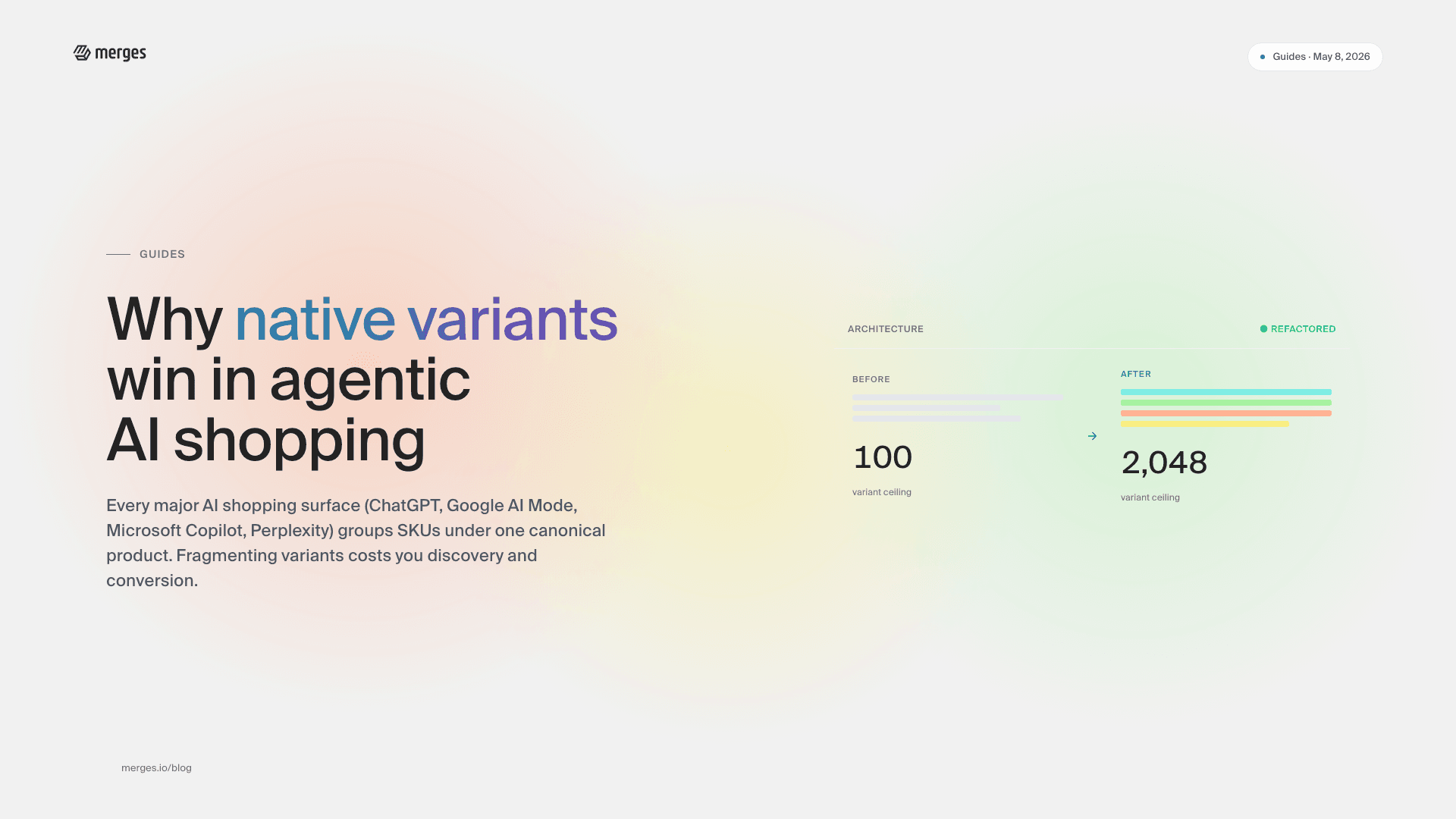
Why native Shopify variants win in agentic AI shopping
Native Shopify variants beat fragmented products in agentic AI shopping. Why ChatGPT, Google AI Mode, Copilot, and Perplexity reward consolidation.
Keep merged products aligned with their sources — mirror inventory, price, compare-at price, SKU, and barcode per location, within seconds, on any paid plan.
A merge creates a brand-new Shopify product with brand-new variant IDs. Anything that keeps changing stock, price, or identifiers — a supplier feed, an ERP, a POS, a 3PL, or a print-on-demand service — writes to the original source products, not to the merged product. Sync original products keeps the merged product aligned with its sources: when a value changes on a source variant, Merges mirrors it to the matching merged variant, usually within seconds.
Sync runs per source location. For each location you turn on, you choose which fields to mirror:
Each field has its own toggle per location. Sync inventory from a supplier location while managing price on the merged product, or mirror everything — the combination is yours, and it can differ from one location to the next.
 Sync original products settings card with per-location field toggles for inventory, price, compare-at price, SKU, and barcode
The panel shows a Syncing X of Y locations counter so you can see how many of your store’s locations are under sync at a glance.
Once the feature is on, the Merged products page shows a Sync status column. Each merged product reports one of five states.
 Merged products list showing the Sync status column with Synced, Queued, Partially, Failed, and Disabled states
| Status | What it means |
|---|---|
| Disabled | Sync is off for this product’s source location. |
| Queued | The product has been indexed and marked for syncing. The first time you enable the feature, working through every product and variant takes a while — products sit in Queued until their turn. |
| Synced | The product and all its variants are in sync. Updates now land within seconds (up to five minutes). |
| Partially | Some variants haven’t synced yet. Click the arrow on the left of the row to expand the variant list and find the one with an error. |
| Failed | The product could not be matched to its original. The usual cause is that the original can’t be found — most often because it was deleted. A merge archives originals rather than deleting them, so deleting an archived original breaks the link. |
If a third-party inventory service removes an item and re-adds it, the matching original changes underneath the merged product. Sync re-indexes by SKU automatically every 24 hours, so a re-added item reconnects on the next cycle with no manual work.
Once a product reads Synced, a change on its source is mirrored within seconds, and at most about five minutes. Very large catalogs can take longer during peak update periods.
Sync original products is a paid feature — the Trial plan does not include it. On paid plans it is gated on two dimensions: how many source locations you can sync from, and the total number of merged variants under sync across all of those locations.
| Plan | Sync locations | Synced variants |
|---|---|---|
| Trial | Not included | Not included |
| Basic | 1 | 2,000 |
| Pro | 3 | 12,000 |
| Unlimited | 5 | Unlimited |
For current prices, see merges.io/pricing.
Two things to know about how the limits behave: